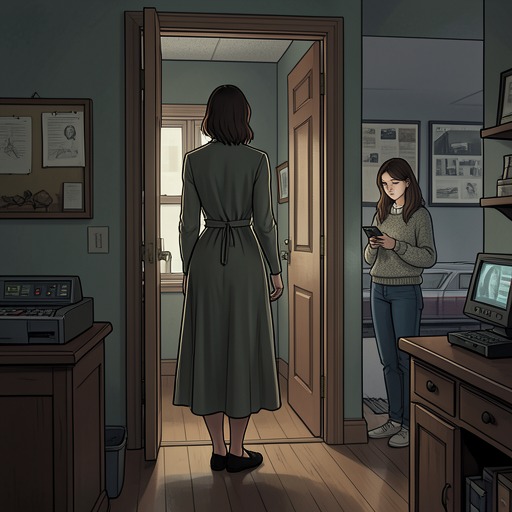
Le couvre-feu de Billie
Cœur de slushLe couvre-feu de Billie is the 11:30 p.m. limit Billie's father imposes as the school year begins, turning time at home into a boundary Billie must negotiate against her desire to see Pierre. The rule is not merely a clock time: it marks the collision between parental care, school-night routine, and a young woman’s insistence that her emotional life cannot wait.
The Rule and Its Setting
The curfew is established in a Monday-night conversation with Billie's father. When she asks to go out, he first points out that school has started and refuses to treat the request as negotiable. Billie counters that she will be in bed by midnight, quietly, with her teeth brushed, makeup removed, and feet washed. Her careful inventory makes the request sound responsible, but it does not change his answer: 11:30 p.m. is his final word.
The limit arrives at a seasonal turning point. The summer job is ending, classes begin the next day, and Billie observes that she has no more time to put magic into ordinary life. The return to school gives the curfew its practical force: the long, bright summer is giving way to a more regulated schedule just as Pierre becomes someone she wants to meet beyond her home town.
Negotiation and Departure
Billie's wish to go out is tied to a specific journey. After hanging up on Pierre's group, she hopes her father will allow her to travel an hour away and spend the evening with him in a university town. At home, she pleads directly, but her father's response remains firm. His hand rests gently on her knee as he tells her school has started; the gesture conveys care even as the rule closes the discussion.
Billie does not simply accept the limit as the evening's end. After agreeing to the stated time, she showers, changes, and calls Daphné, her heart racing. The scene places the father's boundary beside Billie's preparations to leave: obedience is spoken, while anticipation and action point elsewhere.
The Breach and Its Cost
At 1:30 a.m., Billie walks to her Subaru, although she cannot drive, and plans to sleep curled up in the passenger seat. She has missed three calls from her father. In a message, she tells him she is safe and will sleep at a friend's house, withholding the friend's identity; he replies immediately that he is angry. Billie understands that worry, more than anger, is driving him, and feels guilty for making him anxious.
She nevertheless frames the night as necessary for feeding her heart and her life as a woman. That justification sets the curfew's emotional stakes: the breach is an assertion of desire and independence, but it does not erase her attachment to her father or the distress her absence causes him. The rule therefore governs more than a return time; it becomes a measure of the competing claims of freedom and family concern.
Continuing Family Rhythm
The curfew sits within a relationship that is not defined only by restriction. In a later scene, Billie rides a green bicycle while her father takes a purple one from the garage, and the two pedal slowly together, talking about her water-park anecdotes, songs, Daphné, and Annette. Their easy conversation and his laughter show a warm, attentive bond alongside the earlier disagreement.
That later ride also sharpens the meaning of the limit. Billie's father had allowed her to use his old Subaru during the summer because it was safer than cycling along country roads, while he walked to the hospital. As summer gives way to school and the night out tests the 11:30 boundary, the story presents parental protection and adolescent mobility as intertwined rather than simply opposed.